
Friday, October 30, 2009
Amazing Contest!


Thursday, October 29, 2009
Left to Tell--Questions to Consider
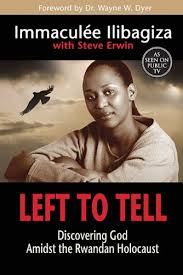
- Early in chapter one Immaculee writes “while my parents were ardent Catholics, they were Christians in the broadest sense of the word” what does she mean by this? Cite examples of the ways her parents lived a Christian lifestyle? What cues could we take from her parents about what a Christian lifestyle looks like?
- Throughout the book Immaculee was surprised at how ordinary people could hold such hatred and be swayed from friend to foe. Discuss this transition and site examples. Why do you think this happens over and over again in our world’s history?
- How does this book instruct us on what it means to have faith?
- What role do her beliefs play in Immaculee’s life as a child, adolescent and young adult and how does that influence her attitude toward other people? (p. 6 –child; p. 22-in high school; p. 32 –at university; p. 34-36 -encounter with mob)
- How does Immaculee feel when childhood friends turn against her, and how does she deal with her feelings about them? (p. 58 & 59)
- What resource does Immaculee call upon to help her deal with the horror of the war? (p. 80)
- Immaculee’s greatest struggle while in hiding comes with her feeling that God wants her to forgive the murderers. (94) Describe how Immaculee acts, feels and makes decisions during this tense and dangerous period.(p. 91-94)
- How does Immaculee’s faith guide her decision-making following her release? (p.107; 184-185; 207-208)
- In what ways is the Rwandan Genocide an example of social sin?
- What do Imaculee’s actions and words teach us about the concept of solidarity?
- “There is more grace in our world than sin and that hope is essential in facing all challenges” – discuss this statement in light of Imaculee’s book. Where do you see flashes of God’s grace in her story? How does hope get her through the genocide?
Friday, October 23, 2009
Christian Symbolism in "Edward Tulane"
I brought the Edward Tulane display home from the library. (Thanks, Cyndi, for dressing the Edwards so beautifully.)

Thanks for those who came. Special thanks to those who came and left and came again.

For refreshments we had carrots, carrot cookies and cookie truffles.
Carrot Cookies
3/4 shortening1 cup sugar
1 egg
1 tsp. baking powder
1 tsp. vanilla
1 cup mashed cooked carrots
1/2 tsp. salt
2 cups flour
1 cup chopped nuts (optional)
Cream shortening, sugar, and egg. Add baking powder, vanilla, carrots, salt and flour. Bake @ 350 degrees for 10 minutes. When cookies are cool, dip in icing.
Icing
1 grated orange peel3 Tbsp. fresh orange juice
1 cup powdered sugar
pinch salt

My cookie truffles didn't look as good as these because they were made in haste, but here is a picture of what they can look like.
Cookie Truffles
1 8-oz. pkg. cream cheese, softened
1 12-oz. pkg. semi-sweet chocolate chips
1 Tbsp. shortening
Crush the cookies into fine crumbs. Combine 3 cups of the cookies and the cream cheese. Shape into 1-inch balls. Combine the chocolate chips and shortening and melt in the microwave. Stir until smooth; dip the balls in the melted chocolate. Place the balls on waxed paper to set up. While the chocolate is still wet, sprinkle with the remaining cookie crumbs. Refrigerate until they are firm, about an hour. Store in the refrigerator. Makes about 40 truffles.
One of the things we talked about during the discussion was the Christian symbolism. What causes people to think that The Miraculous Journey of Edward Tulane is a Christian book:
- DiCamillo instructed her publishers to release the book for spring, a season coinciding with the Easter celebration.
- The illustration of Edward on the cross is a blatant symbol. Even C.S. Lewis, who certainly had an overtly Christian agenda in his fiction, didn't put Aslan on a cross.
- While on the cross Edward was mocked by the birds.
- Edward spends "40 days and 40 nights" in a wilderness, is nailed to a cross, dies after a shared meal, and is resurrected and reunited with a parent figure.
- Edward is a rabbit, which is a symbol of Easter.
- Many names in the book have religious connotations. They include those of three female: Abilene (once a region of the Holy Land), Natalie (which means "birth of the Lord"), and Maggie (often a nickname for Magdalene).
- There are many passages that have parallels in the Bible. One example: Edward begins his journey by leaving "a house on Egypt Street" where he is in bondage to his inability to love. "Remember this day, in which ye came out from Egypt, out of the house of bondage. . ." Exodus 13:13
Some people believe that the Christian imagery may have cost DiCamillo the 2007 Newbery Medal. DiCamillo has not addressed any questions about the Christmas imagery, perhaps because a blunt acknowledgment that Edward is a Jesus figure might also keep the book off school reading lists.
Saturday, October 17, 2009
Hunger Games and Catching Fire


These Young Adult dystopian novels are all the rage right now and those who have read them are impatiently waiting for the third book in the trilogy to be released. (There is no release date yet, but it's expected in the fall of 2010.) Though overwhelmingly popular, a few have accused it of being a rip-off of Battle Royale by Koushun Takami, so I was very interested in reading an interview of the author, Suzanne Collins, where she explains how she got her inspiration. You can read the interview here:
Tuesday, October 13, 2009
Interview with Kate DiCamillo
I thought you might be interested in this interview with Kate DiCamillo. She talks about her new book that came out recently, The Magician's Elephant.
![]()

Saturday, October 10, 2009
October selection
For those who didn't pick up the library's readers' guide:
About the book
Edward Tulane is a china rabbit belonging to 10-year-old Abilene. Edward falls into the sea, after mean boys rip him from Abilene's hands during an ocean voyage. Thus begins Edward's journey from watery grave to the gentle embrace of a fisherman's wife, to the care of a hobo and his dog, and into the hands of a dying girl. Then, pure meanness breaks Edward apart, and love and sacrifice put him back together—until just the right child finds him. With every person who touches him, Edward's heart grows a little bit softer and a little bit bigger. Bruised and battered, Edward is finally more beautiful than ever.
About the author
Katrina Elizabeth DiCamillo (born March 25, 1964) is an American children's author. She is known for her award-winning children's books including Because of Winn-Dixie, The Tale of Despereaux, and the Mercy Watson series.
Born in Philadelphia, Pennsylvania, DiCamillo suffered from chronic pneumonia. At age 5, she moved from Philadelphia to Clermont, Florida for her health with her mother and older brother, Curt DiCamillo. Her mother was a teacher. Her father stayed behind to sell his orthodontic practice and never rejoined the family in Florida. Curt is an architectural historian and lives in Boston. Kate lives in Minneapolis.
DiCamillo majored in English at the University of Florida and worked various jobs after graduation until moving to Minneapolis at age 30. She began writing there while working in a book warehouse, where she met a sales representative for Candlewick Press and submitted a draft of what would become Because of Winn-Dixie.
Her 2003 novel The Tale of Despereaux was inspired by a friend's son, Luke Bailey who asked her to write a story about an unlikely hero with "exceptionally large ears." Luke suffers from a genetically transferred inflamed ear syndrome. Kate DiCamillo sympathized with the boy and promised him a good deal of published rhetoric in attempt to make him feel better.
In 2005, Because of Winn-Dixie was released as a film by 20th Century Fox. The Tale of Despereaux was released in 2009 and The Miraculous Journey of Edward Tulane is currently in production.
Animals feature very prominently in DiCamillo’s books: Winn-Dixie, the stray dog; a caged tiger; Despereaux, the gallant mouse; Edward, the china rabbit and Mercy, the pet pig.
Questions to consider while reading
1. How does Abilene feel about Edward? The day the maid misplaces Edward, Abilene runs from room to room, calling for him. Discuss why Abilene loves him so much. What emotion does Edward feel in return and why? What kind of person is Abilene Tulane? The story leaves Abilene on the deck of the Queen Mary, shouting to Edward, "Come back," as he tumbles into the ocean. Discuss what you think happens to Abilene that day.
2. How and why do all adults (except Abilene's sharp-eyed grandmother, Pellegrina) condescend, or talk down, to Edward? What does it mean to have a condescending manner? Have you ever experienced an adult or a person older than you who condescended to you? How can you tell? Why do you think that person acted that way? How did you handle it?
3. Why does Pellegrina tell the story about a princess who loves no one and is turned into a warthog by a witch to Abilene and Edward? Why is Abilene indignant at the end of the story? What does Pellegrina mean when she says on page 34, "How can a story end happily if there is no love?" What is Edward's reaction to the story? Why does Pellegrina say to Edward, "You disappoint me"? What does she expect of him?
4. Talking of his wife, Nellie, Lawrence says, "She's had her sadness, but she's an all-right girl" (page 61). Why is Nellie sad? Why does she confide in Edward, and how do they help each other?
5. When the old woman hangs Edward on a pole to scare away the crows in her garden, Edward thinks, "I am done with caring." He feels mocked by the stars, which seem to say, "You are down there alone." On page 113, he tells the stars, "I have been loved," and they reply, "What difference does that make when you are all alone now?" Does it make a difference? Why does it matter to Edward that he has been loved? Is there a difference between the love Edward receives from Abilene at the beginning of the book and the love he receives from Sarah Ruth? How are his feelings toward Sarah Ruth different from anything he's experienced before?
6. What are some of the life lessons Edward learns on his journey, through good times and bad? What life lessons have you acquired in your life that you would like to pass on to someone else?
The Miraculous Journey of Edward Tulane
by Kate DiCamillo
About the book
Edward Tulane is a china rabbit belonging to 10-year-old Abilene. Edward falls into the sea, after mean boys rip him from Abilene's hands during an ocean voyage. Thus begins Edward's journey from watery grave to the gentle embrace of a fisherman's wife, to the care of a hobo and his dog, and into the hands of a dying girl. Then, pure meanness breaks Edward apart, and love and sacrifice put him back together—until just the right child finds him. With every person who touches him, Edward's heart grows a little bit softer and a little bit bigger. Bruised and battered, Edward is finally more beautiful than ever.
About the author
Katrina Elizabeth DiCamillo (born March 25, 1964) is an American children's author. She is known for her award-winning children's books including Because of Winn-Dixie, The Tale of Despereaux, and the Mercy Watson series.
Born in Philadelphia, Pennsylvania, DiCamillo suffered from chronic pneumonia. At age 5, she moved from Philadelphia to Clermont, Florida for her health with her mother and older brother, Curt DiCamillo. Her mother was a teacher. Her father stayed behind to sell his orthodontic practice and never rejoined the family in Florida. Curt is an architectural historian and lives in Boston. Kate lives in Minneapolis.
DiCamillo majored in English at the University of Florida and worked various jobs after graduation until moving to Minneapolis at age 30. She began writing there while working in a book warehouse, where she met a sales representative for Candlewick Press and submitted a draft of what would become Because of Winn-Dixie.
Her 2003 novel The Tale of Despereaux was inspired by a friend's son, Luke Bailey who asked her to write a story about an unlikely hero with "exceptionally large ears." Luke suffers from a genetically transferred inflamed ear syndrome. Kate DiCamillo sympathized with the boy and promised him a good deal of published rhetoric in attempt to make him feel better.
In 2005, Because of Winn-Dixie was released as a film by 20th Century Fox. The Tale of Despereaux was released in 2009 and The Miraculous Journey of Edward Tulane is currently in production.
Animals feature very prominently in DiCamillo’s books: Winn-Dixie, the stray dog; a caged tiger; Despereaux, the gallant mouse; Edward, the china rabbit and Mercy, the pet pig.
Questions to consider while reading
1. How does Abilene feel about Edward? The day the maid misplaces Edward, Abilene runs from room to room, calling for him. Discuss why Abilene loves him so much. What emotion does Edward feel in return and why? What kind of person is Abilene Tulane? The story leaves Abilene on the deck of the Queen Mary, shouting to Edward, "Come back," as he tumbles into the ocean. Discuss what you think happens to Abilene that day.
2. How and why do all adults (except Abilene's sharp-eyed grandmother, Pellegrina) condescend, or talk down, to Edward? What does it mean to have a condescending manner? Have you ever experienced an adult or a person older than you who condescended to you? How can you tell? Why do you think that person acted that way? How did you handle it?
3. Why does Pellegrina tell the story about a princess who loves no one and is turned into a warthog by a witch to Abilene and Edward? Why is Abilene indignant at the end of the story? What does Pellegrina mean when she says on page 34, "How can a story end happily if there is no love?" What is Edward's reaction to the story? Why does Pellegrina say to Edward, "You disappoint me"? What does she expect of him?
4. Talking of his wife, Nellie, Lawrence says, "She's had her sadness, but she's an all-right girl" (page 61). Why is Nellie sad? Why does she confide in Edward, and how do they help each other?
5. When the old woman hangs Edward on a pole to scare away the crows in her garden, Edward thinks, "I am done with caring." He feels mocked by the stars, which seem to say, "You are down there alone." On page 113, he tells the stars, "I have been loved," and they reply, "What difference does that make when you are all alone now?" Does it make a difference? Why does it matter to Edward that he has been loved? Is there a difference between the love Edward receives from Abilene at the beginning of the book and the love he receives from Sarah Ruth? How are his feelings toward Sarah Ruth different from anything he's experienced before?
6. What are some of the life lessons Edward learns on his journey, through good times and bad? What life lessons have you acquired in your life that you would like to pass on to someone else?
Monday, October 5, 2009
Jeannette Walls' New Book

For those of you who enjoyed The Glass Castle, Jeannette Walls has published a new book, which has received good reviews. This time it is her maternal grandmother's story, told in first person. (It is subtitled a true-life novel.) It is being released tomorrow but is already in the library (though it is checked out at the moment).
From Publishers Weekly
"For the first 10 years of her life, Lily Casey Smith, the narrator of this true-life novel by her granddaughter, Walls, lived in a dirt dugout in west Texas. Walls, whose megaselling memoir, The Glass Castle, recalled her own upbringing, writes in what she recalls as Lily's plainspoken voice, whose recital provides plenty of drama and suspense as she ricochets from one challenge to another. Having been educated in fits and starts because of her parents' penury, Lily becomes a teacher at age 15 in a remote frontier town she reaches after a solo 28-day ride. Marriage to a bigamist almost saps her spirit, but later she weds a rancher with whom she shares two children and a strain of plucky resilience. (They sell bootleg liquor during Prohibition, hiding the bottles under a baby's crib.) Lily is a spirited heroine, fiercely outspoken against hypocrisy and prejudice, a rodeo rider and fearless breaker of horses, and a ruthless poker player. Assailed by flash floods, tornados and droughts, Lily never gets far from hardscrabble drudgery in several states—New Mexico, Arizona, Illinois—but hers is one of those heartwarming stories about indomitable women that will always find an audience."Saturday, September 26, 2009
The Water and the Blood

Because we enjoyed These Is My Words so much we were excited to read Turner's second novel, The Water and the Blood.
Summary:
Philadelphia “Frosty” Summers buckles under the small-mindedness of her family and the rest of the inhabitants of Sabine, Texas. She goes along with a group of kids who set fire to the “Nigra” church and keeps quiet when she learns that the church wasn’t empty of parishioners. When she finally does take the initiative and moves to Southern California to work in a factory for the WWII war effort, she falls in love with a Navajo Indian Marine radio operator, only to put their relationship, not to mention their lives, in jeopardy when she brings him home to meet her family.
© 2003 by April Galt for Curled Up With a Good Book
Most of us enjoyed it, though not as much as These Is My Words. The story line was a little confusing to follow at first, it took a while to care about the characters, and there were some unexplainable and irritating things about Frosty, i.e. letting Gordon go hunting with rotten-to-the-core men and trying to throw herself off the cliff, but for me, at least, it was a worthwhile read overall. I enjoyed the different ways of looking at and responding to prejudice and I enjoyed Turner's depiction of the Navajos. Not to nitpick, but several of us noticed the reference to Corrie ten Boom. Where was her editor? And the typeface was so hard to read!
Questions:
- Frosty clearly loves the congregation of Missionary Way--a source of escape from her turbulent situation at home. What factors in her life compel Frosty to destroy the very structure that seems to bring her solace?
- Frosty's depiction of the South is rich with sensory imagery--smells, colors, and tastes. What colors run through her story and what symbolism is attached to each? Why does Frosty describe her surroundings in these terms?
- What does the word "water" in the book's title represent? How is water used as a symbol throughout the book?
- On page 210, Frosty describes a fruit stand on the highway stacked with "sweet Texas melons." How are "black children" used in this fruit metaphor, and why?
- What is at the root of the attraction between Frosty and Gordon? Does their future seem to hold a "happily ever after"?
- Grandma Summers and Gordon both experience forms of prejudice--Grandma reveals her own feelings of resentment at the end of the novel. How have both characters reacted to the prejudice they have faced? Does one seem more justified? For whom do you have more sympathy, and why?
- At first, why doesn't Gordon tell Frosty about his time in the Japanese internment camp? When he finally does tell her, on page 298, she responds with compassion. How does he respond to her kindness, and why?
- The men who take Gordon hunting clearly have a destructive plan in mind, but what is their true intent? Do they want Gordon dead? How do their actions toward Gordon in the swamp compare to the act of burning down Missionary Way as young boys?
- What makes it so difficult for Frosty to do the right thing in the end? How has she changed from being self-centered (as with her plan to rescue children so she will be heralded as a hero) to self-sacrificing?
- At the end of the novel, what dynamic is present in the relationship between Frosty, her mother, and her sisters, Opalrae an Delia? Frosty and Delia see to come to terms with each other--how convincing is their reconciliation?
Subscribe to:
Posts (Atom)